

This spring, communities across metro Atlanta celebrated an important milestone: more students than ever are earning high school diplomas. These gains matter. Behind every diploma is years of hard work from students, families, educators, and school communities. Higher graduation rates represent real progress and open doors to future opportunities for countless young people across our region. Equally important is ensuring that a diploma represents meaningful readiness for what comes next.
In her recent op-ed, “Restoring Meaning to High School Diplomas,” RedefinED Atlanta’s Executive Director, Angira Sceusi, notes that while rising graduation rates are worth celebrating, a diploma should signify more than completion – it should also reflect readiness for what comes next. She adds that indicators such as the Georgia Milestones proficiency rates and college- and career-readiness measures suggest that many students continue to face academic challenges even as graduation rates rise. Understanding whether students are developing the skills needed for future success requires looking at multiple measures of school performance. One important piece is student achievement.
What is Student Achievement?
Within the Atlanta Schools Data Project (ASDP), Achievement measures the percentage of students who score proficient or above on the Georgia Milestones assessment. In simple terms, the Achievement score shows how many students are meeting grade-level expectations on state assessments.
For elementary and middle schools, ASDP combines results from English Language Arts, Mathematics, Science, and Social Studies. For high schools, the score is based on the four End-of-Course (EOC) assessments. Because the score includes multiple subjects and grade levels, it provides families and community members with a broad picture of how students are performing academically at a school.
Why Achievement Matters
Achievement data helps families move beyond overall school ratings and better understand what is happening inside a school. For example, achievement data can help families answer questions such as:
- Are students meeting grade-level expectations?
- Is the school improving over time?
- Are students performing similarly across different subjects?
- Are there areas where students may need additional support?
No single data point can tell the whole story about a school. However, achievement data provides families and communities with important information that can help them ask questions, celebrate progress, and advocate for students.
Understanding Achievement Through ASDP
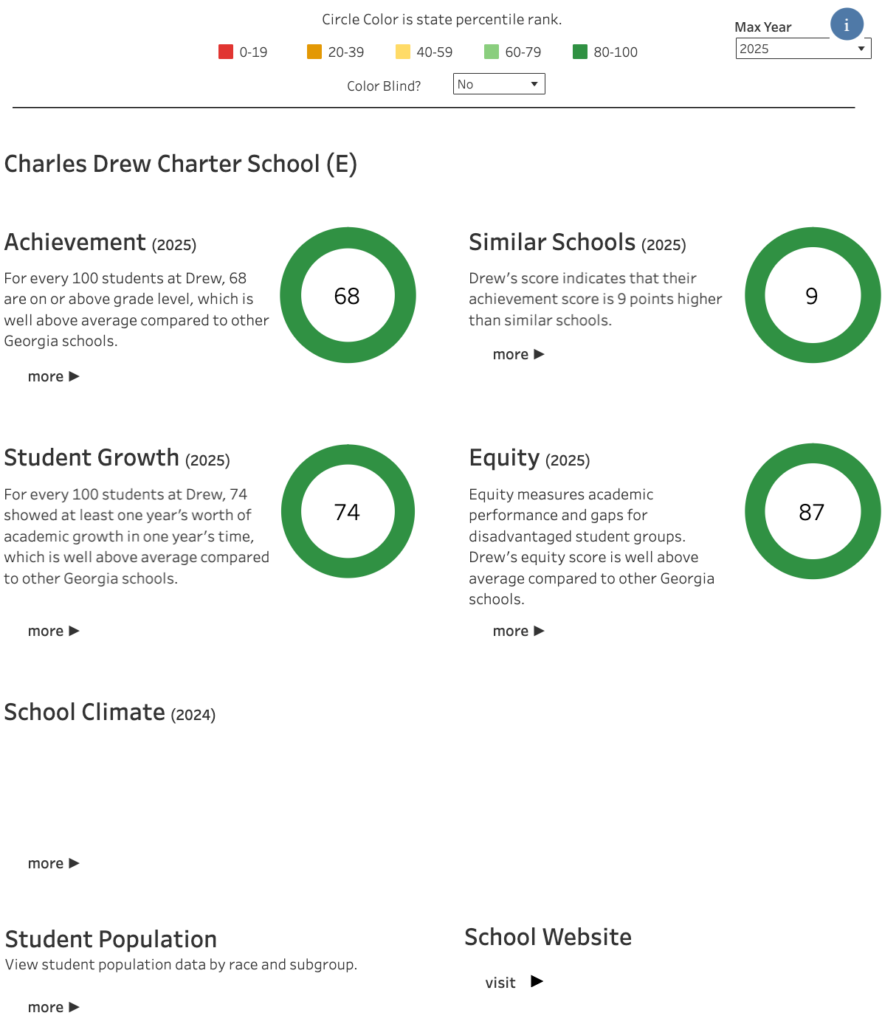
Within ASDP, families can explore student achievement directly on a school’s Overview page, alongside other measures such as Student Growth, Similar Schools, Equity, and School Climate. In the example below, Charles Drew Charter School received an Achievement score of 68. This means that for every 100 students attending Drew, approximately 68 students scored proficient or above on the Georgia Milestones assessment, well above the average for Georgia schools.
Clicking “More” under the Achievement section opens a more detailed view of student performance. In the example, families can quickly see that approximately 6 out of 10 students at Drew are meeting grade-level expectations in English and about 7 out of 10 are meeting grade-level expectations in Math.
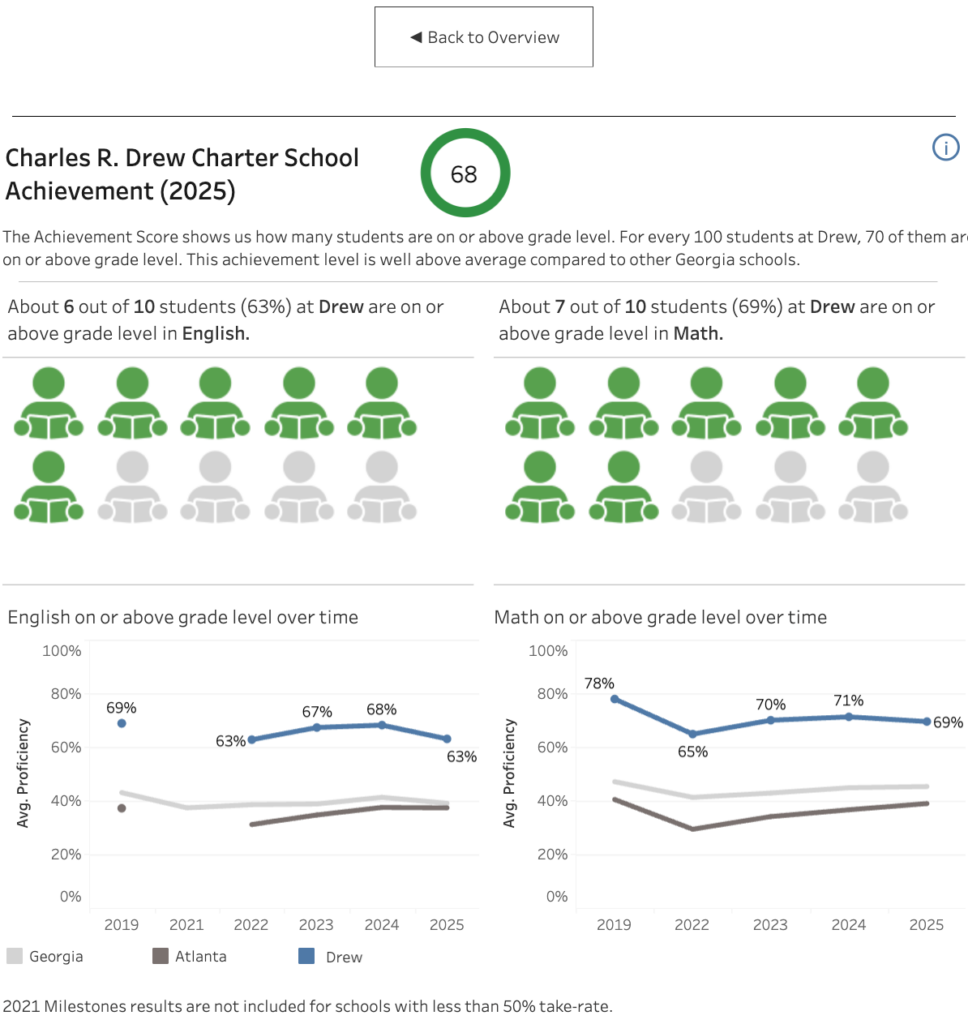
The detailed page also displays achievement trends over time and compares school results to district and state averages, helping families better understand how their school is performing and whether student outcomes are improving. For a fuller picture, achievement data should be considered alongside other ASDP measures. For example, schools with lower proficiency rates may still demonstrate strong student growth, while schools with high achievement do not always demonstrate strong growth every year. Looking across multiple measures helps families move beyond a single score and toward a more complete understanding of school performance.
Making Data Informed Decisions
Families deserve school information that is easy to understand. School quality is complex, and no single score can capture everything that happens within a school community. Achievement data does not tell the entire story, but it does provide important information about whether students are meeting grade-level expectations. When families understand school data, they are better equipped to ask questions, engage with school leaders, advocate for their children, and celebrate the successes happening within their communities.
As metro Atlanta continues working to ensure every student graduates prepared for their next step, understanding student achievement is one important way families and communities can better understand how schools are serving students.