

Georgia’s latest Milestones results brought encouraging news for math. Statewide proficiency increased in most tested grades, and several Metro Atlanta school systems continued to make progress from very different starting points.
In Part I of our look at the 2026 math results, we focused on broader trends across the region. Atlanta Public Schools, Marietta City Schools and Clayton County all posted gains, while the results also showed how uneven math performance remains across Metro Atlanta. This analysis moves beneath those system averages to focus on three schools showing different types of math progress. Amana Academy West Atlanta is performing above statewide proficiency rates across every reported grade, Resurgence Hall pairs high proficiency with strong student growth, and Ethos Classical has made sizable gains despite remaining below statewide proficiency levels.
Proficiency tells us how many students met or exceeded the state’s expectations, while student growth captures how much progress students made over time. Looking at both gives us a more robust view of where students are gaining ground. While we highlight differences in how these schools approach teaching and learning, the math results alone cannot tell us whether those approaches contributed to their progress. Instead, they offer a closer look at the work happening behind the numbers.
To explore math results for other schools across metro Atlanta, use our interactive Milestones visualization to filter by school, grade and year.
Amana Academy West Atlanta (K-7)
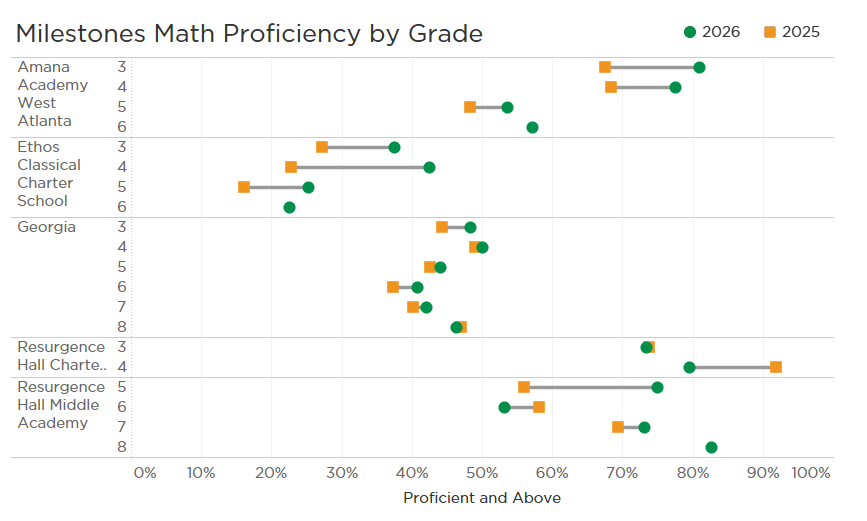
Amana Academy West Atlanta stands out in the 2026 results. Every reported grade performed above the corresponding statewide rate. 3rd grade math proficiency reached 81%, up 13.5 percentage points from the prior year, while 4th grade increased 9.1 points to 77.5%. 5th grade reached 53.7%, and the school’s first 6th grade cohort posted 57.1%. Student growth was particularly strong in 4th grade, where 97% of students showed typical or high growth. 6th grade also showed strong growth, with roughly 81% of students meeting that threshold, while 5th grade growth was more mixed.
Amana Academy West Atlanta’s approach to instruction emphasizes hands-on learning and the integration of STEM across subjects. The campus is rooted in the Expeditionary Learning (EL) Education model, which combines project-based learning with design thinking. The school also has a dedicated math instructional coach to support its approach to teaching and learning.
Resurgence Hall Charter School (K-8)
Resurgence Hall Middle Academy offers one of the clearest examples of high proficiency and strong growth showing up together. 5th grade math proficiency climbed 19 percentage points to 75%, 7th grade reached 73.1%, and 8th grade 82.7%. 6th grade declined from the prior year but remained above the statewide rate, as did every tested grade at the school. Growth points in the same direction. Roughly 8 in 10 students in both 7th and 8th grade showed typical or high growth.
Resurgence Hall takes a different approach to organizing instruction, combining dedicated time for blended learning with the use of student-level data to inform instructional support. Students participate in 85 minutes of blended literacy and math learning each day, moving between adaptive technology and face-to-face instruction. The school uses the student-level information generated through those tools to identify where students are excelling and where they may need additional support. Its broader model also includes an extended school day, computer science and design thinking. Resurgence Hall Elementary uses the same academic model and posted similarly strong math results in 2026.
Ethos Classical Charter School (K-7)
Ethos Classical (Ethos) enters the picture from a different starting point. Its math proficiency rates remain below statewide levels, but several grades moved substantially from 2025 to 2026. 4th grade proficiency increased nearly 20 percentage points to 42.5%, while 3rd and 5th grades each gained roughly 10 points. There are encouraging growth signals as well. Roughly 77% of students in the school’s new 6th grade cohort showed typical or high growth, while 4th grade growth also improved considerably from the prior year. At the same time, Ethos had weaker growth results in the preceding years, so 2026 is better understood as an encouraging one-year improvement than evidence of a sustained trend. Ethos still has considerable ground to cover, but the size of this year’s gains across several grades makes the results worth watching.
At Ethos, math instruction is organized into distinct parts of the school day focused on building fluency, applying mathematical concepts, and deepening students’ conceptual understanding. Math at Ethos is divided into several distinct parts of the school day. One block focuses on fluency, another uses Cognitively Guided Instruction to work through word problems and real-life applications, and a third focuses on conceptual understanding through Eureka Math and Zearn.
What Comes Next
The school-level results show several different versions of progress. Amana West is already performing at comparatively high levels and continues to gain ground in several grades. Resurgence Hall pairs high proficiency with strong student growth. Ethos remains further from statewide proficiency but posted sizable one-year gains across multiple grades. There is no single approach running through all three.
Assessment data cannot tell us which or how individual pieces of those models are driving the differences we see. What it can do is point us toward places worth understanding more deeply. Part I showed that Metro Atlanta’s recent math progress is real but uneven. Looking beneath those system averages brings some of that progress into sharper focus and gives us a more specific set of schools to keep watching as the region works to turn recent gains into sustained improvement.