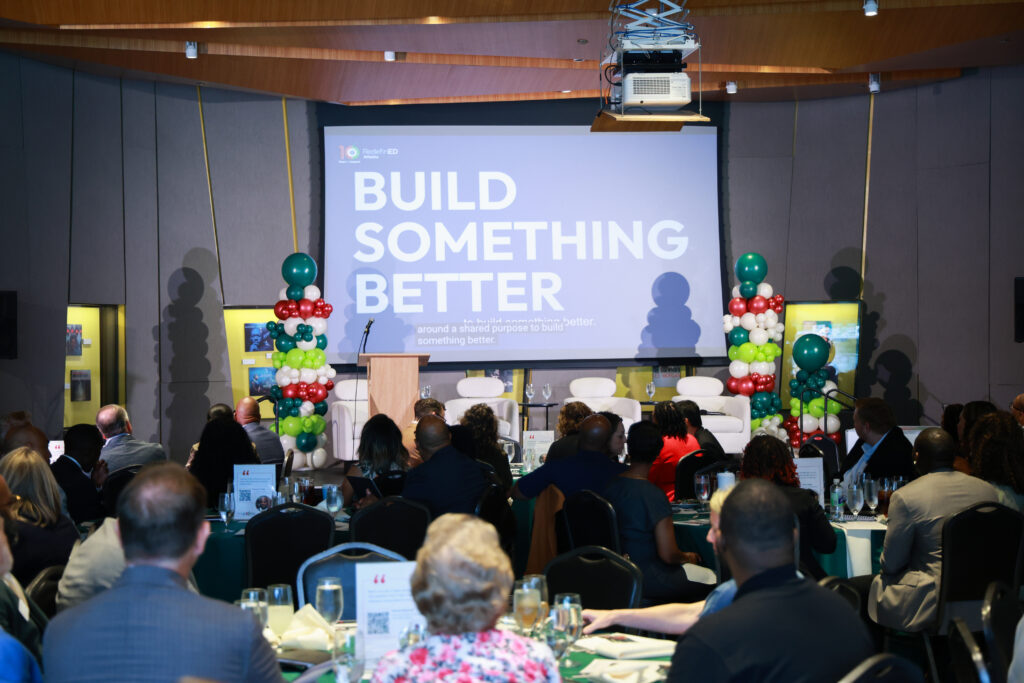
Since 2018, our annual speaker series has been our way of convening Metro Atlanta around the most pressing and promising ideas in public education. This year, we were joined by education leaders, policymakers, funders, and community voices for a focused conversation on how Georgia’s approach to funding public education, particularly through the Quality Basic Education (QBE) formula, connects to the realities students face today and the workforce needs of tomorrow.
For nearly four decades, Georgia has funded public education through the QBE formula, creating a foundation for supporting schools across the state. But Georgia’s schools have significantly changed—students’ needs have evolved, communities have shifted, and expectations for public education have expanded—creating an urgent need for our funding to evolve as well.
“It made perfect sense when they created it in 1985,” said panelist Dr. Cayanna Good, Deputy Commissioner for Innovation and Impact at the Technical College System of Georgia and Chair of the State Charter Schools Commission of Georgia. “But today, on the ground, it looks like students are learning in buildings that smell heavily of mildew because there isn’t enough money to provide better facilities.”
“It’s a classic example of a thousand things being thrown together to try and address every piece of education, instead of one comprehensive plan,” added panelist Mark Dixon, President of A+ Education Partnership.
Before the panel began, Dr. Dana Rickman, President and CEO of Georgia Partnership for Excellence in Education, explained how the funding formula generally works.
“It’s impossible to explain in such a short time, especially considering Georgia has one of the most complex formulas in the country. Most important to today’s conversation are its gaps: technology, school safety, and health and wellbeing. It was built for a 1985 classroom, before cellphones and laptops and the internet as we know it today. It doesn’t account for computers for every student, much less school counselor ratios–which are way above recommended– or psychologists and social workers.”
We know that getting funding into schools, especially schools with high levels of poverty, is vital. Panelist Dr. Keith Colbert, Senior Chief of Staff for Academics and District Operations at Clayton County Public Schools, explained, “When you look back 40 years ago, the needs of today’s students have increased tenfold. The funding should follow those student needs.”
“We’ve seen the research that shows when you increase funding to a school by $1,000 it equates academically to an additional 72 days of learning,” added Mark Dixon. “It can close achievement gaps by one-third to one-half.”
But the question remains: what funding formula is the right one?
While there isn’t one clear answer, the key takeaways were clear:
- Fund students, not programs. Base funding should flow to districts as flexible, per-student dollars instead of allocations tied to predetermined costs, so leaders can direct resources based on what students need the most.
- Fund the students and communities who need more, more. For the first time, districts could earn substantial new funding for economically disadvantaged students, including those with disabilities and English learners. Also, rural communities and small school systems should receive additional resources because it costs more per student to run them.
- Reward results and workforce readiness. A portion of state investment could reward student success, with funding tied to outcomes that matter for college, careers, and beyond, so we can keep Georgia’s workforce strong and responsive to the needs of a modern economy.
- Make the system fairer for all public schools. Charter schools face persistent funding gaps for facilities and transportation, which a modern funding formula should account for, so more students have the same opportunities to learn. However, additional investments should ensure no district or charter loses funding during the transition.
- Advocate for what works. Use your voice and influence to help create policies and resources that sustain proven strategies benefiting students and teachers over the long term. Systems change is how we make excellence possible at scale.
- Engage with ongoing conversations. Systems change takes time and continued conversation, so it’s imperative to keep showing up to convenings like this one, to keep learning, and to keep searching for new ways to make public schools better for all students.
Philanthropy can also play a critical role, especially as concerns around economic stability rise. “Philanthropists have the unique opportunity to help pilot programs and build proof points,” said Dr. Good.
“Philanthropists can also help innovate the systems and programs that help students access great opportunities,” added Mark Dixon.
Georgia is at a critical juncture when it comes to funding reform. Our future workforce, entrepreneurs, leaders, and citizens are in classrooms today and a formula that doesn’t invest in them shortchanges not only the students but our whole community. Without a modernized funding system, a student’s opportunity is still shaped by where they live and learn (and by decisions made over four decades ago).
In the words of Dr. Rickman, “It’s not about the money. It’s about the sort of systems we are putting money into.”
Modernizing how Georgia funds public education won’t happen through one conversation or one solution. It will require policymakers, educators, community leaders, funders, families, and advocates to keep asking hard questions, learning from what works, and pushing for systems that reflect what students need today. That is why conversations like A City Changing matter. When we bring people together around the same table and have conversations grounded in data, informed by experience, and focused on what is possible—we create the conditions for meaningful change to bloom. At RedefinED Atlanta, we’ll continue to convene those conversations and work alongside our partners toward a future where every student has access to the resources and opportunities they need to thrive. Together, we can turn insight into action and action into #ACityChanging.
Watch the full recording
Join Us
- Be first to know: Subscribe to our newsletter for updates on more important news
- Catch up: Watch past recordings and catch up on our conversations.
- Partner with us: Interested in sponsoring the series or bringing a cohort from your organization? Reach out to Tiffany Scott, Associate VP of Development.