
Math Milestones data was released in early August; with it, we’ve been able to analyze math proficiency across districts, schools and specific subgroups. Georgia’s math recovery continued in 2026, with proficiency increasing in grades 3-7 and Algebra. However, progress over the years is occurring at very different rates throughout Metro Atlanta. That variation matters. It can help us move beyond asking whether math scores are improving and start asking where momentum is building and what we might learn from the districts improving more consistently and rapidly.
“The updated math data is promising, but the gaps we see are still representative of deeper issues. We need to identify scalable solutions for math in the same way we’ve built a set of resources designed to tackle literacy,” said Angira Sceusi, RedefinED Atlanta’s Executive Director and recipient of United States Congressional Recognition for her contributions to STEM education.
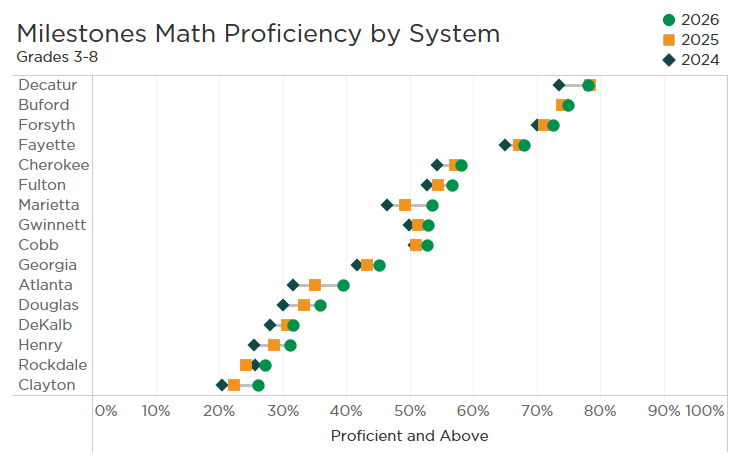
Metro Atlanta’s math recovery (2024-26)
- State: Across grades 3-8, statewide math proficiency increased from 41.7% in 2024 to 45.3% in 2026
- Atlanta Public Schools (APS): proficiency rose from 31.6% in 2024 to 35.0% in 2025 and 39.6% in 2026 – an eight-point gain in two years, more than twice the state’s improvement over the same period. That growth narrowed APS’s gap with the state from roughly 10 percentage points to fewer than six
- Marietta City Schools: grew 7.2 percentage points, moving from 46.4% to 53.6% between 2024 and 2026.
- Clayton County: increased from 20.5% to 26.3% over the same period.
- Fulton: reached 56.8% proficiency in 2026, continuing to improve from an already higher starting point.
Progress is real but it isn’t uniform
The same data that shows momentum also shows how much outcomes continue to vary across the region, illustrating an important distinction: growth and performance tell us different things. Clayton is gaining ground quickly but remains well below the state. Fulton is improving from a much higher baseline. APS is doing something particularly notable – it has sustained faster growth over the past two years. Visit our interactive Milestones visualization to compare Metro Atlanta school systems from 2019 to 2026. Additional tabs let you explore results by school, grade, and student group.
In 2026, grades 3-8 math proficiency among the Metro Atlanta systems ranged from 26.3% in Clayton to 78.2% in City Schools of Decatur. DeKalb, meanwhile, increased from 28.1% in 2024 to 31.7% in 2026, but because the state improved at almost exactly the same pace, its gap with statewide performance barely changed.
Those differences are not explanations by themselves. School systems serve different communities, face different challenges, and begin from different starting points. But they suggest deeper questions:
- If APS has gained eight points in two years, what is contributing to that trajectory?
- What can we learn from Marietta’s sustained improvement?
- What will it take for systems like Clayton to sustain faster growth long enough to close larger proficiency gaps?
- And importantly, what happens when we look beneath these system averages at the individual schools and communities driving that progress?
From tracking progress to learning from it
This year’s results give us a clearer picture of where progress is happening across Metro Atlanta and where there is still more to understand. The data does not point to one school system, sector, or program as the answer to the state’s math challenge, but it does give us places to examine more closely. This is critical as Atlanta begins to assess what greater coordination around math could look like. We have already seen sustained, coordinated attention around literacy. Math may require a different approach, but the progress already underway gives us a strong place to start. This year’s math Milestones open the door to conversations about how we can build sustained math progress, and deliver it to a more uniform base of students across the Metro Atlanta area.