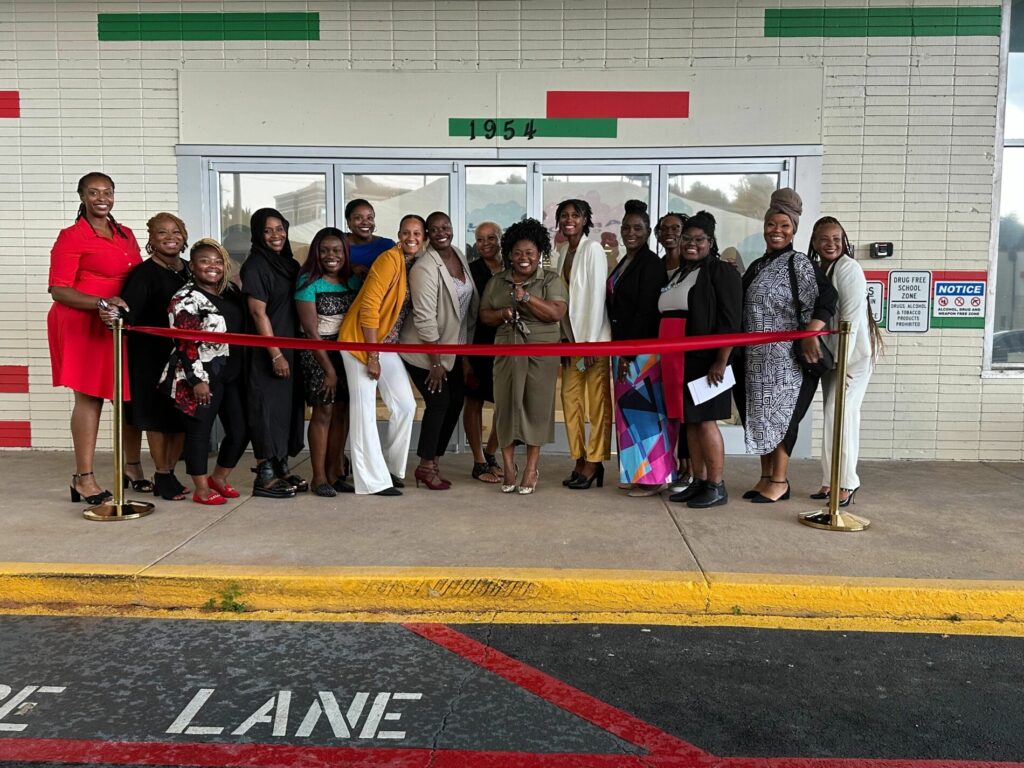
On Aug. 7, 2023, PEACE Academy welcomed students into the building for the first time. The only state charter-approved public school in Georgia with a culturally inclusive curriculum, this milestone marks the culmination of an enormous, inspired and coordinated effort on behalf of students.
Founder Ebony Payne Brown describes some of the pivotal moments, starting from the beginning when she worked with the Georgia Charter Schools Association’s Charter Incubator program, a competitive year-long endeavor that recruits and trains leaders to start public charter schools in the state. “I didn’t have funding, and I had a full-time job,” she says. “We had to be resourceful, working with community members and volunteers.”
One of the biggest tasks was securing the place where their students would thrive. Many grants explicitly state that they cannot be used for funding facilities, so the assistance from RedefinED Atlanta was instrumental for understanding the commercial real estate market, finding an old warehouse to renovate and hiring architectural and construction teams. RedefinED Atlanta believes developing new schools and investing in district initiatives will transform Atlanta into a city where every child attends a great public school.
An Environment That Increases Learning Capacity
After successfully navigating through the many complexities, PEACE Academy is now delivering on its vision. A daily cultural studies class focuses on intentional cultural immersion that helps students appreciate their heritage and the world as a rich and beautiful place with diverse and beautiful people. Monthly real-world questions offer opportunities for exploration and problem-solving. Related field experiences give students exposure to community organizations, educational pathways and potential careers. The curriculum also includes twenty-first-century skills like coding. In addition, reading and literacy underpin everything, along with opportunities for family involvement.
“So many Black and brown students have a hard time finding a school in their area that is high performing and that accepts their cultural identity. If you remove your identity as you step into school, it’s a weight, and it lowers your brain capacity,” says Ms. Payne Brown. “We want students to show up as they are, celebrating everyone who comes into the building, with their capacity to learn enlarged.”
The school’s three educational pillars include being culturally responsive, inquiry-based, and community-centered. “Many traditional schools are based on memorizing versus having field experiences and learning how to develop your own solutions,” Ms. Payne Brown says. “We want our students to build critical thinking skills and enter fields and careers that emphasize those skills.”
Bringing a Dream to Fruition
Ms. Payne Brown emphasizes how necessary early funding and support were to achieving this dream when the school was nothing but an idea. “I 100% could not have done this without funding from organizations like RedefinED Atlanta,” she says. “To receive a grant for planning, a grant for the opening year, all before data or results, believing in me and my leadership made the journey possible.” Having opportunities for professional development and attending conferences also made a huge difference.
Early support helped expand and fine-tune the vision through visits to schools around the globe with High Tech High and the Georgia Charter Schools Association incubator program. “In Washington, D.C., I visited a school that had the most collective style of learning I’ve ever seen, with a morning meeting and students leading so much of the work,” Ms. Payne Brown says. “And there was an inquiry-based model in San Diego where the level of autonomy and creativity blew my mind and changed my image of what students could do in terms of projects.”
She also mentions the critical role of the incubator cohort. “It’s extremely helpful to have multiple partners along on this journey who are also opening schools, to have regular meetings, share what we are doing and bounce ideas off of each other.”
Now that the school is open, what’s next? Ms. Payne Brown notes that while they are now fully staffed, her position includes both principal and executive director, overseeing the curriculum and fundraising. She would like to see those responsibilities divided into two positions. “We also want to get to a point where we have so much interest that we have to consider opening another school to provide even more families with an innovative public school option like ours,” she says. “But shorter-term, we want every child to finish this year feeling they have grown and have a place that loves them and cares about their educational experience.”