
Over the past months, we have looked at various student-level data. Last month, the Georgia Department of Education (GaDOE) shared the statewide Georgia Milestones results for the 2021-2022 school year (SY). The state required Milestones for 2021-2022 testing after canceling the mandate for state assessment in response to COVID-19 in 2020. Schools across Atlanta Public Schools (APS) saw significantly higher participation rates, enabling us to better understand the scale of pandemic learning loss.
This month, the National Assessment of Educational Programs (NAEP) released its biannual nationwide assessment of student academic achievement in public and private schools across the United States. Both sets of data highlighted a few similar themes:
- learning loss from the pandemic was significant,
- learning loss was steeper in math than in reading, and
- students who struggled before the pandemic were likely to have greater levels of learning loss.
National data from NAEP showed that scaled reading scores for 4th graders dropped by five points, which represents the largest decline in reading scores recorded since 1990. Meanwhile, the 4th-grade math scale scores declined by seven points. This is the first time that NAEP results have shown a decline in math scaled scores. This aligns with what occurred in Georgia, too.
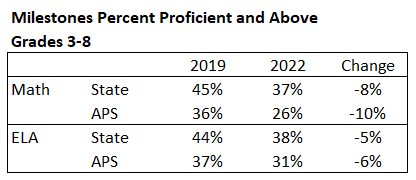
Upon reviewing Georgia Milestone results between 2019 and 2022, proficiency across the state in grades 3-8 fell by eight percent in math and five percent in English Language Arts (ELA).
Another way to understand the data is that for every 100 students, eight did not meet the proficiency bar in math, and five did not meet the proficiency bar in ELA.
The larger drops in math both at the national and state level align with projections noted in our summer 2020 learning loss report, Quantifying the Impact of School Closures on Metro Atlanta Student Proficiency.
These learning loss trends were also prevalent across APS. In APS, grades 3-8 ELA proficiency fell by six percent. Likewise, math proficiency in grades 3-8 fell by 10 percent.
Students who are not yet proficient have even more pronounced results. NAEP scaled scores fell the most for students who were furthest behind before the pandemic.
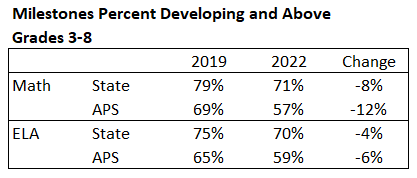
This result was also consistent in APS with the Georgia Milestones results. Using developing and above Georgia Milestones scores, APS saw six percent declines in 3-8th grade reading and 12 percent declines in 3-8th grade math. When accounting for students in the developing and above category, the larger drops in math suggest there was greater learning loss with our students who entered the pandemic behind grade level.
Learning Loss Varied Even Among Similar Schools
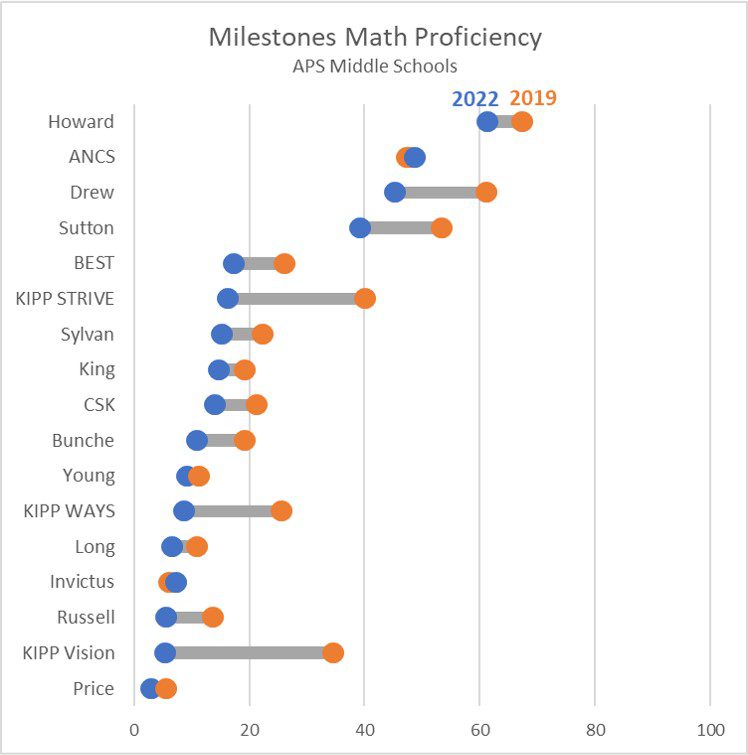
NAEP has not yet released state or district-specific data, but the Georgia Milestones results include school-specific data. The state-level data shows that students and schools in under-resourced neighborhoods still need more support to recover from pandemic-era learning loss. However, the relationship is not the same in all cases. Using APS Insights data, we see that poverty matched up with Milestones performance. Still, schools with similar socioeconomics have as much as a 40-point difference in the percentage of students scoring developing and above on Milestones.
The Milestones Math Proficiency graph shows that test score changes from 2019 to 2022 have a wide variation by the school.
Although the test scores from 2019 and 2022 were under different circumstances, we believe it is important to see the changes to understand the extent of learning loss at each school.
A New User-Friendly Way for Community to Understand the Data
In the spring of 2022, we soft-launched our Atlanta Schools Data Project to collect feedback regarding what is most helpful for different users. We designed the tool to organize publicly available data and make it accessible for APS parents, caregivers, and community members to understand.
The tool does not determine what makes a great school; there is no amount of data that can determine what a student’s experience will be at a school. However, with information at hand for all, we can drive impact for the over 50,000 students that rely on Atlanta Public Schools for their education, setting them up for a lifetime of success.
So what’s next at APS?
A press release from APS mentions the district’s Academic Recovery Plan and The APS 5, five measurable methods to guide their academic strategy, based on the district’s five-year strategic plan: Data, Curriculum and Instruction, Whole-Child Intervention, Personalized Learning, and Signature Programming.
- In 2022-2023, the district will focus on effective implementation of and support for the academic strategy and monitor the plan’s progress through district and state data.
- In 2023-2024, the district will continue monitoring the plan’s progress, assessing, reviewing, and making adjustments based on the data.
Now more than ever, we are committed to working alongside and supporting APS to realize its vision: “a high-performing district where students love to learn, educators inspire, families engage, and the community trusts the system.”
Forward, together.
We know public school systems exist to drive positive student outcomes and improve them when necessary. However, for generations, inequity in Atlanta’s public schools continues to disproportionately impact Black and Brown students and students living in under-resourced communities.
With the lingering impact of COVID-19 on students’ proficiency, we must all move with urgency to support students, encourage bold and innovative ways to accelerate learning, and close the opportunity gap. We believe now is the time to reimagine public education. We can develop a new delivery system for Black and Brown students and students from under-resourced communities to give every student opportunities, a sense of well-being, and self-determination.
Citation: The math comparisons include 2019 eighth-grade end-of-course results to create a more accurate comparison to 2022, when all eighth-grade students were required to take the eighth-grade EOG math exam.