Metro Atlanta is at a turning point, and we need strong collaboration between our community’s leaders to ensure that students across regions have access to high-quality, trajectory-changing public schools. As part of our 2026–2028 Strategic Plan, we’ve committed to advancing system improvements in partnership with districts, policymakers, and other community partners, which is why we are proud to support DC360.
DC360 is a collaborative, community-driven initiative designed to ensure that every family in the Frederick Douglass High School attendance zone, also known as the Douglass Cluster, has access to thriving schools and thriving neighborhoods. Anchored in RedefinED Atlanta’s unique expertise, including collaborative planning, data analysis, and shared learning, DC360 aligns partners around common goals, coordinated action, and measurable progress.
The Douglass Cluster has a rich legacy, resilient families, and strong community pride. Yet, long-standing inequities have limited access to high-quality education and neighborhood opportunity. DC360 aims to change that, not through isolated programs, but by connecting systems, sharing data, and amplifying community leadership to drive lasting change.
“As a Black man doing place-based work in a community shaped by both deep legacy and deep inequity, I know that conversations about displacement and gentrification are not abstract,” explained Dr. Lawrence Harris, RedefinED’s Executive Fellow leading DC360. “They are personal. They are historical. They live at the intersection of race, income, power, and opportunity. What stood out to me most during a recent collaborative convening was the honesty in the room, the willingness to name the hard truths, and to push one another to acknowledge that we cannot talk about schools, development, or investment without also talking about the elephants in the room. This work, as far as I know, has not been done before in this way, precisely because it requires that level of honesty. And that is exactly why we are committed to it, because development without displacement is not just a slogan, it is a responsibility, and one I take seriously.”
Inside the Room Where it Happens
Facilitating this work isn’t easy, and Dr. Harris has been leading it with thoughtfulness and intentionality, allowing the community to guide the work. The following are just a few examples of the ways in which he has been engaging with the community:
Collaborative Meetings
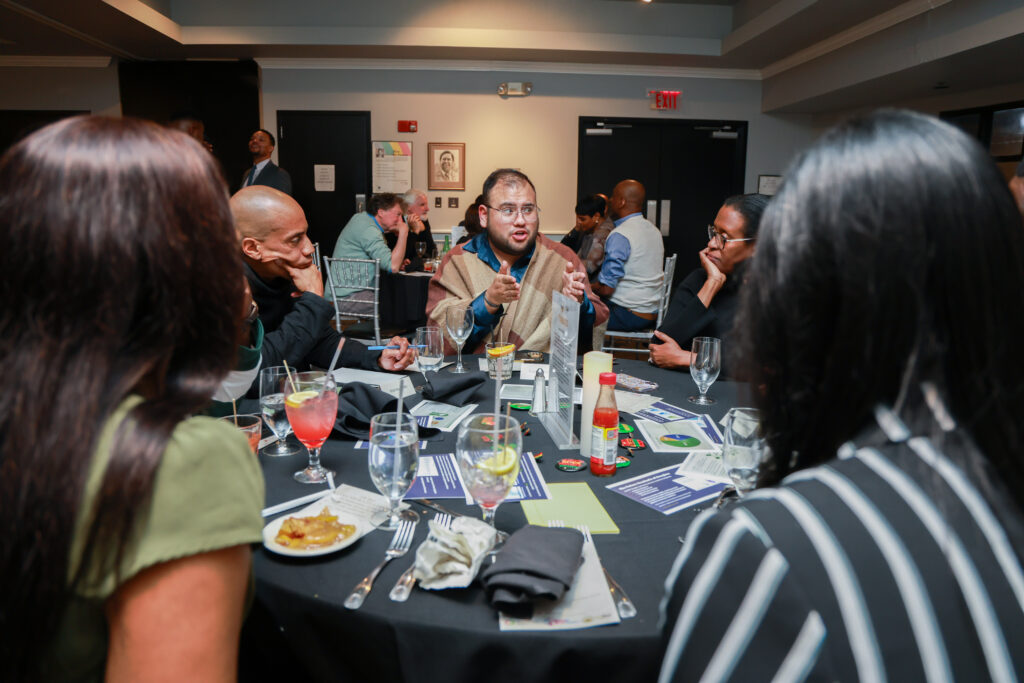
By hosting regular partner meetings, we reinforce the work as a truly community-driven effort. This is where we foster the honest and necessary conversations around displacement, gentrification, race, and income, grounded in lived experience, data, and shared responsibility. These conversations have also proven that there are strong intersections between housing stability, safety, and educational opportunity, all of which directly inform DC360’s place-based approach.
Dr. Harris also explains how these spaces are an opportunity to engage with community leaders across sectors: “The presence of Mayor Andre Dickens and Superintendent Dr. Bryan Johnson at the recent DC360 Dinner shows that we sit at an important intersection of education, city leadership, and community voice.”
Attendees leave collaborative meetings energized and prepared to drive the work forward with a clear and shared vision.
Direct Engagement
Dr. Harris also facilitates conversations with partners across the Douglass Cluster, learning more about existing community-led efforts, coordinating collaboration, and advancing shared progress. For example, a conversation with Mariama N’Diaye, the Innovation Team Director with the City of Atlanta, will increase community voice at collaborative meetings through the use of representative data.
Participation in local groups and meetings also yields valuable insights into the community’s unique culture and priorities. So far this year, Dr. Harris has attended the Grove Park + Bankhead Working Group meeting, joining both the Education Subcommittee and the Economic Mobility Subcommittee, and the Reinvest Forward meeting.
“These conversations have continued to highlight the importance of coordinated, neighborhood-level investment as we move into development,” said Dr. Harris.
Education & Systems Alignment
Representing the culmination of our work, ensuring strong alignment not just across the Douglass Cluster but across the entirety of the Metro Atlanta education system is vital to long-term success.
To that end, attendance at events such as the Atlanta Partners for Education (APFE) Advisory Committee Meeting and the unveiling of the Educational Opportunity Survey (2nd Edition), hosted by 50CAN and Edge Research, is necessary for the Douglass Cluster’s inclusion in future developments and to provide important context on how families are experiencing opportunity.
Looking Ahead
Over the coming months, DC360 will continue to lead a comprehensive needs assessment, learning from within the Douglas Cluster community the strengths, challenges, and priorities to advance opportunity and excellence.
Dr. Harris said it beautifully, “Progress has never come easily, and it has never come without courage, honesty, and collective effort. I’m grateful for the way this community continues to lean into complexity rather than shy away from it. This season of the work feels like both momentum and responsibility, where we choose to honor the past while helping build something stronger and more just for what comes next.”